Should an EdTech Platform Raise Its Prices?
An Indian EdTech platform had a relatively simple pricing structure: one subscription plan priced at ₹1,499 per month.
The plan bundled recorded courses, tests, live classes and mentor/career support into a single subscription. The business was growing, but management faced a familiar issue:
Are we charging the right price for what we're providing?
Simply increasing the subscription price would be easy.
The harder thing was whether the company could improve its economics by redesigning the pricing structure itself.
The analysis therefore considered three possibilities:
Keep the existing single-plan model.
Reprice the existing single plan.
Introduce multiple tiers with different prices and feature bundles.
The objective was not to maximize revenue alone.
It was to determine the pricing structure that produced the strongest contribution economics while respecting commercial constraints.
The platform had approximately 8,000 active subscribers at an average price of ₹1,499 per month. Its monthly economics were:
| Metric | Current |
|---|---|
| Subscribers | 8,000 |
| Monthly price | ₹1,499 |
| Monthly revenue | ₹11,992,000 |
| Variable cost / subscriber | ₹410 |
| Monthly contribution | ₹8,712,000 |
| Contribution margin | 72.6% |
| Monthly churn | 5.8% |
Contribution was calculated as:
Contribution=(Price−Variable Cost)×Subscribers
The business therefore generated substantial contribution under its existing model.
But the single price created a potential problem: customers with very different willingness to pay were receiving essentially the same product at the same price.
Understanding Customer Response
Historical pricing observations showed that demand declined as price increased.
| Monthly Price | New Subscribers/month | Monthly Churn |
|---|---|---|
| ₹1,199 | 2,350 | 4.7% |
| ₹1,299 | 2,180 | 4.9% |
| ₹1,399 | 2,040 | 5.2% |
| ₹1,499 | 1,920 | 5.8% |
| ₹1,599 | 1,770 | 6.1% |
| ₹1,699 | 1,610 | 6.7% |
| ₹1,799 | 1,430 | 7.4% |
| ₹1,899 | 1,250 | 8.3% |
However, customers were not equally price-sensitive.
The customer base was approximately:
65% students
35% working professionals
The professional segment was considerably less price-sensitive than students.
That raised an important strategic question:
Why charge customers with different willingness to pay the same amount?
The Competitive Context
The platform also sat between several different competitive propositions:
| Competitor | Monthly equivalent | Core proposition |
|---|---|---|
| EduMax | ₹999 | Recorded courses |
| SkillPro | ₹1,499 | Courses + tests |
| CareerEdge | ₹2,299 | Courses + mentor support |
The existing ₹1,499 plan therefore sat in an interesting position.
It was priced around the middle of the competitive market, while providing features that approached the higher-value proposition.
This suggested that the problem might not be simply underpricing.
It might be poor price-to-value segmentation.
The Pricing Model
Rather than treating pricing as a single-variable decision, I modelled it as a constrained optimization problem.
The candidate architecture contained three tiers:
Basic
Recorded courses + tests
Plus
Basic + live classes
Pro
Plus + mentor/career support
Candidate prices were evaluated for each tier.
The model incorporated:
price sensitivity
customer segmentation
expected subscriber response
variable costs
contribution margin
competitive positioning
tier price relationships
existing-customer transition constraints
The optimization objective was:
Maximize expected contribution while satisfying the company's commercial constraints.
Constraints
The pricing solution had to satisfy several conditions.
Contribution margin
Each tier needed to maintain at least a 65% contribution margin.
Price architecture
Pro needed to be at least 25% more expensive than Plus.
Plus needed to be at least 25% more expensive than Basic.
Existing customers
The effective price increase for existing customers could not exceed 10% during the transition.
Professional customers
At least 20% of professional customers needed a path to the Pro tier.
Student accessibility
Basic could not exceed ₹1,199 per month.
These constraints prevented the model from simply selecting whichever price generated the largest theoretical contribution.
The Result
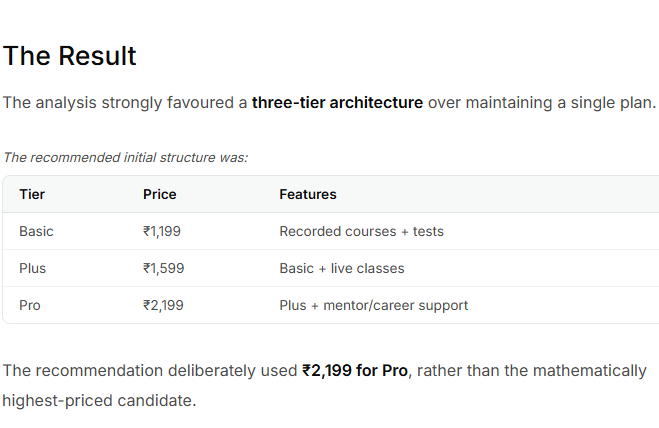
The analysis strongly favoured a three-tier architecture over maintaining a single plan.
The recommended initial structure was:
| Tier | Price | Features |
|---|---|---|
| Basic | ₹1,199 | Recorded courses + tests |
| Plus | ₹1,599 | Basic + live classes |
| Pro | ₹2,199 | Plus + mentor/career support |
The recommendation deliberately used ₹2,199 for Pro, rather than the mathematically highest-priced candidate.
That distinction became important during sensitivity analysis.
The Economics
Under the recommended pilot structure, the model estimated:
| Metric | Current | Recommended |
|---|---|---|
| Subscribers | 8,000 | 7,367 |
| Monthly revenue | ₹11,992,000 | ₹14,929,009 |
| Monthly contribution | ₹8,712,000 | ₹11,908,443 |
| Contribution margin | 72.6% | 79.8% |
The result:
+36.7% monthly contribution
while accepting an estimated 7.9% reduction in subscribers.
This is an important distinction.
The recommendation did not attempt to maximize subscriber count.
It accepted some volume loss in exchange for substantially stronger unit economics.
Why Not Simply Raise the Price?
A single-plan analysis produced an interesting result.
The demand model suggested that higher prices could continue increasing revenue and contribution over the tested range.
At first glance, that might suggest:
Raise the price as much as possible.
But that conclusion was not accepted.
Why?
Because the underlying professional-segment elasticity was −0.5.
Under the constant-elasticity demand function used in the model, that elasticity makes revenue—and therefore contribution under the model's assumptions—continue increasing as price rises.
Mathematically, the model therefore has no finite optimum.
That is a property of the assumed demand function.
It is not evidence that customers would happily pay unlimited prices.
When the Model Becomes Too Confident
The optimization model ranked ₹2,599 as the highest-contribution Pro price among the candidates.
At ₹2,599, the model estimated approximately ₹13.36M in monthly contribution.
But this recommendation was rejected.
Why?
Because the underlying elasticity estimates were based on relatively small price movements.
Moving from ₹1,499 to ₹2,599 represents approximately a 73% increase.
That is an enormous extrapolation beyond the region in which the demand relationship was observed.
A model can produce a precise number while still being wrong about the world.
So rather than presenting ₹2,599 as the answer, the analysis treated it as a signal:
The model suggests additional pricing power may exist—but the available evidence is not strong enough to justify assuming it.
Recommendation
The recommended strategy was therefore not:
“Raise the price to ₹2,599.”
It was:
Introduce a three-tier pricing architecture and test it.
The initial pilot would use:
₹1,199 Basic
₹1,599 Plus
₹2,199 Pro
The Pro tier would capture additional willingness to pay from customers who value live support and career/mentor services, while Basic would preserve an accessible entry point for more price-sensitive students.
The company could then use actual customer behaviour to evaluate:
tier adoption
conversion
churn
upgrades
downgrades
revenue per customer
contribution per customer
segment-level price sensitivity
Those observations would provide better evidence for subsequent pricing decisions than extrapolating the original demand model indefinitely.
The Strategic Insight
The analysis revealed that the company's opportunity was not necessarily “charge more.”
It was:
Charge differently for different levels of value.
The existing ₹1,499 plan was effectively giving customers access to a relatively high-value proposition without distinguishing between customers who primarily wanted course content and customers who valued live instruction and career support.
A tiered architecture creates a mechanism for capturing some of that difference in willingness to pay.
And importantly, it does so without requiring every customer to absorb the same price increase.
What This Case Demonstrates
This analysis illustrates several principles of quantitative pricing strategy:
1. Revenue is not the same as economic value
A pricing decision should consider contribution, not simply the number of customers or gross revenue.
2. Customer segments matter
Different customers can have materially different price sensitivity and willingness to pay.
3. Pricing architecture can matter more than the headline price
The strategic question isn't always “What should we charge?”
Sometimes it is:
“What should we charge whom, and for what?”
4. Optimization does not eliminate judgment
A mathematical model can identify an attractive candidate without proving that the candidate is commercially realistic.
5. Extrapolation risk matters
Demand estimates are strongest near the data from which they were derived.
A model predicting behaviour 73% outside the observed price point deserves skepticism.
6. Pricing should be treated as an experiment
When the evidence is insufficient to justify an aggressive move, a controlled pilot can generate better information while limiting downside risk.
Final Recommendation
| Option | Price |
|---|---|
| Price Basic | ₹1,199 |
| Plus | ₹1,599 |
| Pro | ₹2,199 |
The model estimates that this structure could increase monthly contribution by approximately 36.7%, from ₹8.71M to ₹11.91M, despite a projected decline in subscribers.
Use the model to identify where the opportunity is. Use a controlled pilot to discover whether the opportunity is real.
Case type: Illustrative quantitative analysis
This case uses constructed business data to demonstrate a pricing-strategy methodology. The company, figures and observations are illustrative rather than a client engagement.
Have a problem like this?